Wednesday, September 12, 2012

Wisdom gleaned from CCAI Reports

There is much to be learned by reading through CCAI's annual Foster Youth Internship Report.

Each year, there is one particular topic that resonates with me deeply.

In 2011, I kept nodding my head at the following quotes from "Improving Accountability by Tracking Youth Outcomes in Care:"      *pg. 38

  • "The current system lacks crucial data on the life outcomes of youth in foster care."
  • "True reform of the foster care system depends on whether we are willing to measure ‘what counts’ – and what counts are the life outcomes of youth both in and after aging out of care."
  • "The tragedy in Rosie’s story is not just that she aged out of care unable to develop permanent connections or take care of herself, but that the child welfare agency was neither aware of nor held accountable for Rosie’s ultimate well-being."
  • "While Rosie was in care, the child welfare agency was required to collect information on several factors, such as how many times her social worker visited the home or whether she was enrolled in school. What the agency was  not expected to report on were details pertinent to her life outcomes such as her educational attainment, mental health and emotional and social development. "   
  • "The agency was not even asked to report on whether Rosie was self-sufficient enough to live independently . To the child welfare agency, the only outcome that mattered regarding Rosie was that she aged out from care."
  • "Until the child welfare system and the funding that supports it are structured in a way that both tracks and supports successful outcomes, reform will continue be constrained and the success of our youth in foster care will continue to be thwarted." 
The suggestion made in 2011 was to create and maintain "an effective database that will produce outcome-driven results needs to incorporate data from children who are at a younger age than seventeen and assess where the foster system is unable to provide youth in care with the skills and services they need to be successful ."

This year,  my heart and mind responded immediately to the section of CCAI's Foster Youth Internship Report titled, "Life's Transitions Do Not Happen Overnight:"  *pg. 56
  •  "Life's transitions are a critical part of human development."
  • "The current foster system is designed with the expectation that the transition from adolescence into adulthood can occur overnight."
  • "Autonomy plays a critical role in adolescent development; however... the strict rules and regulations placed on foster  youth by the state, foster parents and group home staff limits the amount of independence the youth experience."
Three areas of autonomy, vital to adolescent development were described:
  1. Emotional Autonomy: Shifting from reliance on parents to developing a circle of people upon who they can rely... This includes the growing ability to navigate relationships.
  2. Behavioral Autonomy: Making decisions independently and acting on those choices. Having the freedom to make decisions, even experiencing the consequences of those decisions within a safe environment, is a cornerstone to developing personal judgement.
  3. Value Autonomy: Developing the ability to think critically and make judgements involving higher-level thinking, such as attitudes and beliefs.
The recommendation made in 2012 is to incorporate a halfway house model into transitional living programs for foster youth. This model would include housing, job training, and the development of a network of relationships, in order to help our young people to "transition into adulthood with the knowledge, support and skills they need to succeed in life."


Sunday, August 05, 2012

At the end of the day, what did YOUTH think?

When it comes to the 2012 Connecting the Dots Conference for Foster Care Teens and Young Adults, it is the YOUTH perceptions regarding the day went that are most important.

These are some of the comments from evaluations submitted by the 200 youth in attendance at the conference:
  • Please keep this going, I love every bit of it. I feel and see that even people that don’t know me would like to see me succeed in life, and that gives me all the tools I need to keep my head up and stick to my road of success. 
  • I loved it ☺ 
  • I liked everything 
  • It was really good 
  • Loved everything 
  • I really liked the connecting the dots conference because I know there is other people out there like me 
  • Great conference!! I learned a lot. 
  • I loved it 
  • I love the whole event 
  • I really enjoyed the whole thing
  • I enjoyed myself and I’m glad that I came. A lot of teens should come. 
  • I loved being here and would come back again 
  • All the classes helped me a lot and I really feel that I have learned some important things today 
  • A very fun event! 
  • Enjoyed myself 
  • It was a nice lesson in all – the Suits are one my favorite lessons 
  • It was a very good experience 
  • It was a fun learning experience that I hope to be a part of again
  • Positive 
  • A very enlightening event  
  • I think every course I did was great and I think they should be repeated next time (referring specifically to Financial Aid resources, Keeping Your Life in Balance, Job Interview Role-Plays) 
  • I think they did a good job with giving out information 
  • Had a great time. Food was good. 
  • I thought it was all very helpful. I learned a lot at all of the events 
  • I loved everything about it 
  • Love to listen to the outlook of what others had to say about their experience and how they will help foster children to voice what is best for them 
  • It was very fun, useful and organized 
  • I really enjoyed all the classes 
  • I think this is a good program 
  • Great program 
  • I think that this is a great program. Thank you. 
  • It was fun and exciting
  • AWESOME 
  • Had a good time 
  • I had a great time 
  • I think it was a great day overall 
  • I would love to come again. Everything was helpful. 
  • I would be glad to come back next year and be one of the speakers and put forth my ideas to reach out to children that grew up like me
  • Very good turnout. Staff was very nice. 
  • I want to thank you for your time and helpfulness
  • It was a fun event and I hope to do it again. 
  • I like all of the workshops that I attended – they were fun but very helpful.
  •  I received the right help
  • I feel more confident about my future 
  • I would like to come to these each year 
One young lady just wrote "Thanks" on the evaluation, over and over again, for each workshop category, ending with “Thanks so much” and a heart at the end.

Connecting the Dots Conference makes the front page of the Columbus Dispatch

The 2012 Connecting the Dots Conference for Foster Care Teens and Young Adults was featured on the front page of the Columbus Dispatch on Saturday, August 4, 2012.

CLICK ON EACH IMAGE TO VIEW:


Monday, July 23, 2012

What's Your Motivation and Vision?


One day, a traveler came across three stonecutters working in a quarry. Each was busy cutting a block of stone. Interested to find out what they were working on, he asked each man, one by one, what he was doing.
  •  The first man said, “I’m earning my pay: we have to get a certain number by end of day.” 
  •  The second man said, “I’m the best stonecutter here; I’m faster and better than others.” 
  •  The third man looked up at the sky with vision and purpose, and said,“I’m building a cathedral.”    


What’s Your Stone in the Wall? 
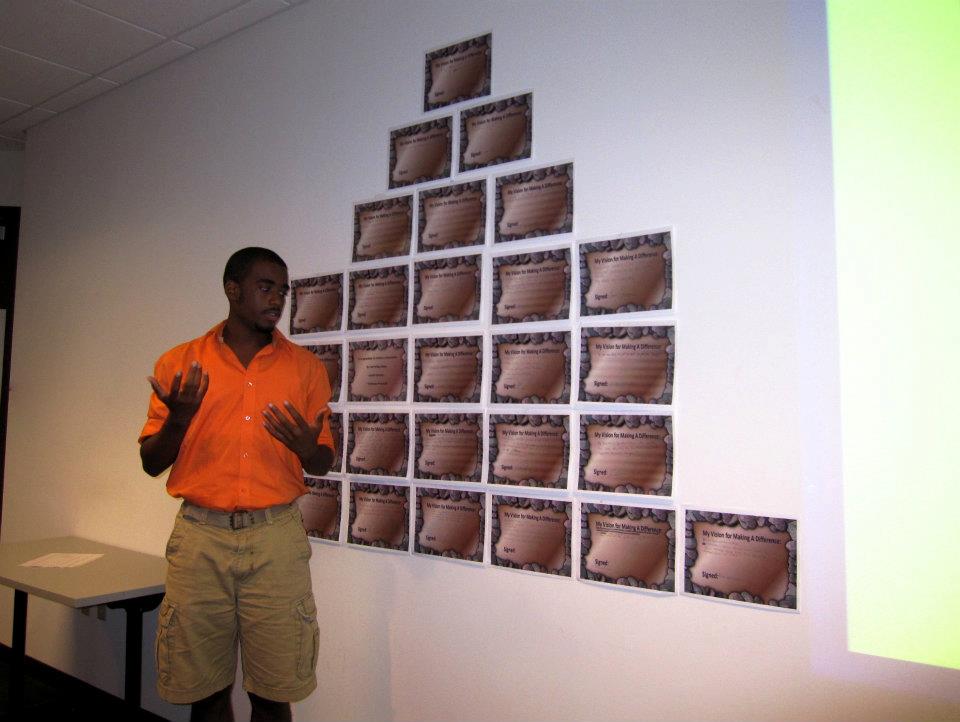
During the July 2012 Ohio Youth Advisory Board meeting, participating youth filled out template with their personal vision for making a difference.

Here are some of their responses...


  • "Never forget: "Nothing about us without us" ~ Jackie W.  (ally of the foster care movement)
  • "Form a partnership with youth and see them as a resource and learn from them!" ~ Rebecca H. (ally of the foster care movement)
  • "Empower youth to develop their skills and get more involved in child welfare. My vision is to have younger youth getting involved so that they can advocate and become well-rounded about the system, so that they can build on the difference we made and make even more and even better changes than we did." ~ Active youth advisory board member


  • "To teach children how to dance and also become a social worker. Make sure that all children I encounter have a dream and will never be afraid to follow it, because everyone is important no matter what their dreams are." ~ John D. 
  • "To change the outlook of foster care by showing that everyone has a path to walk down with a choice." ~ Katelen B. 
  • "Break the status quo, and make the transition from foster care to adulthood as easy and fair as possible. Empower youth to share their voices with boldness. Change the outlook that society has on foster care. We are not where we came from -- we are where we are going!" ~ unsigned
  • "Have a plan for all kids coming into foster care so that they will not have to go through what I went through. I want foster youth who have been through the system to step up and make a change for other youth in the system. Because as the vision says, us foster youth can and will make a difference." ~ Latrelle S.

  • "I want to be a lawyer so that I can help other foster children find a good home to live in." ~ Terry K.
  • "Help all youth find a home with trust by telling adoptive parents that no one is perfect, they just need to be a friend to foster youth in need." ~ Alexander F.
  • "To be the best father I can be" (breaking the cycle of foster care) ~ Cory G.
  • "Use my story to put myself in people's shoes." ~ Javon J. 
  • "Talk to kids that are in the system and try to give them advice in how to deal with certain things and people and how to get to where they want to be in life." ~ Michaela B. 
  • "Give other youth a voice and opportunities to speak out." ~ Destiny W. 

  • "To change the opinions and view of the foster care system, and help people understand what it is really like" ~ Victoria W.
  • "To be a leader and lead by example." ~  Lisa H.
  •  "Help others continue to better themselves and never give up, just like I will never give up. My vision is to be a foster care alumni that everyone remembers because they would see that I tried and worked to make a difference for youth in foster care." ~ Dominique J.
  • "To make a difference in others' lives and help others who need help." ~ Kaytie R.
  • "Be a mother for those who do not have a mother (when I am older)." ~ Kia W.


  • "Changing school policies that penalize foster kids when they move from one home to another by not allowing them to continue to participate in team sports" ~ Zachary M.
  • "Help foster parents and social workers better serve youth." ~ Thora George
  • "Normalizing foster care. Closing the gap between regular teens and foster teens." ~ Alegha P.
  • "Change the way things are and the way they have to be. Create a lifestyle of foster care, not a system." ~ Adrian M.
  • "Encourage others to be more understanding. Impact children all over the world greatly. Help others help themselves." ~ Brianna C. 

  • "To go to college for Criminal Justice, minoring in Music Education. I also plan to start a nonprofit business for underprivileged youth, both in and out of foster care. I hope to mentor youth who have no stable mentor in their lives."  ~ Vinney M.
  • "Help myself in order to help others. Talk to other youth and engage them. Go to college and pursue my career. Gain knowledge and progress. Grow!!!" ~ Michael B. 
  • "Maker sure every youth in Ohio hears my story and can be encouraged by it. Also, so they can have faith to move on with their life through any trials." ~ De'Stanie W. 
  • "Show people that I can change my life and show that I'm not going to be a lifer." - H. C.
  • "Gain in knowledge and process, and grow. Keep in touch with all the connections I made and keep networking with the YAB and other groups even after I age out" ~ Dominique J. 

Thursday, June 14, 2012

Advice for Foster Care Alumni When Working With Teens

Nine times out of ten, when I volunteer my time as a foster care alumna to reach out to teens and young adults of today, they are incredibly receptive.

But not always.

And why on earth should I expect them to be?


I still remember being that 14 year-old in an all-girls group home, pissed off and bored out of my mind, and not hesitating to "smart off" to staff members. I was in pain, and sometimes it felt better if the people around me felt some of the hurt, too.


I also remember that, at age 15 and 16, I "tested" the very staff members that I respected the most - because I wanted to see if they would still care..

So, after a challenging experience on Monday, I've been mulling it over and have come to the following conclusion as a Life Lesson:

Always remember who you are, and where you came from -- it keeps you humble and makes you strong. And hopefully, it will also give you compassion and patience for others... Because you once were where they are now -- and really, at that time, did you need one more person to judge you? 


Maybe what you really needed at that time was someone who was willing to: 

  • Look below the surface 
  • See beyond the tough shell you created in order to protect yourself 
  • Ignore the smart-aleck remarks that came so easily and freely at the time 
  • And, just for once, UNCONDITIONALLY love you

I am willing to live up to this charge, with no illusions that doing so will always be fun...

Friday, June 01, 2012

Kudos to NACAC

Kudos to the NACAC Board of Directors for passing a position statement identifying services and supports that should be provided to youth at risk of aging out of care and those who do leave care without a permanent family.

Wednesday, December 21, 2011

State of Young America: Youth Housing


According to The State of Young America: Economic Barriers to the American Dream:

The share of young households spending more than 30% of income on rent was stable for two decades, but grew after 2000 to reach 41% in 2009.


Long-term economic trends, rising rental costs, and the Great Recession can all be seen in the decision to move home with parents.

The State of Young America: Student Financial Aid


According to The State of Young America: Economic Barriers to the American Dream:

Student financial aid has not kept up with increasing costs. In 1980 the maximum Pell Grant covered 69% of attendance, today it covers 34%.

The State of Young America: Lower Earnings for Young Adults Without a High School Diploma


According to The State of Young America: Economic Barriers to the American Dream:

Young men without a high school diploma have experienced a 28% drop in earnings since 1980. Young women’s earnings also lost ground, dropping 8 percent.


Monday, December 19, 2011

Authentic Youth Engagement


The Jim Casey Youth Opportunities Initiative recently released a publication titled: Authentic Youth Engagement: Youth-Adult Partnerships.

Unpacking the "Why" Behind Authentic Youth Engagement:
  • "Engaging adolescents in planning and decisionmaking regarding their own lives—and the larger community—reaps critical benefits throughout the process of transitioning to adulthood."
  • "Emerging knowledge in the field of neuroscience tells us that during adolescence and young adulthood the brain is undergoing extensive remodeling and that experience plays a critical role in how the brain matures."
I completely agree that:
  • "Young people in foster care have often been removed from natural opportunities for decisionmaking, community engagement, and leadership and they experience a sense of powerlessness and isolation."
  • "The intentional creation of leadership and community engagement opportunities is therefore particularly important for this group of young people."
Read more in this excellent resource...

Friday, December 02, 2011

What If Every State Had Foster Care Medical Review Panel?


What if every state had a Foster Care Medical Review Panel, serving in a role similar to a Medical Ombudsman, that foster care youth, alumni, foster parents, CASA/GAL, etc. could contact with  concerns about over-medication?   


Forgotten Children A Special Report on the Texas Foster Care System Comptroller Carole Keeton Strayhorn (April 2004)

Findings

  • DPRS exercised little meaningful oversight over the treatment of foster children with psychotropic medications.
  • No formal investigation related to psychotropic medications had ever been conducted.
  • YFT did not attempt to assess the appropriateness of medications.
  • Many foster children were being prescribed psychotropic medications by physicians who were not trained in child psychiatry.
  • Even though federal law requires a foster child’s medical records to be reviewed, updated and given to foster care providers, foster care providers of 46% children in a study conducted by the OIG never received medical histories of the children in care, including children with serious medical conditions.   Without access to a child’s medical records, it was difficult for foster parents to effectively care for foster children.

Challenges Noted:
The Advisory Committee recognized that “[c]oncerns exist regarding the inappropriate use of psychotropic medication and inadequate monitoring of prescribed medications.  


There was also a lack of data available regarding physician prescribing practices and child outcomes.  Children in foster care may be subject to widely varied standards of care.  There is currently no way to monitor the quality of care and no system for resolving concerns associated with the use of psychotropic medication for children. 


Also there is no method for “second” opinions to be easily obtained by DFPS staff when they have concerns or questions.”

In response, their plan was to:
  • Develop review panels of medical professionals including (trauma-informed) child psychiatrists to provide recommendations regarding care for foster children where there is a question on whether their care is clinically appropriate.
  • Establish clinical guidelines and protocols for psychotropic medications and a review process for identifying children’s medical records that fall outside the guidelines and reviewing them for inquiry or possible corrective action.
  • Develop a medical and educational passport for each child that follows the child through placement changes and is readily available to healthcare providers and schools electronically.

The Financial and Societal Costs of Medicating America's Foster Children


A Senate hearing was held yesterday, "The Financial and Societal Costs of Medicating America’s Foster Children."

Mr. Bryan Samuels, Commissioner, Administration on Children, Youth and Families, U.S. Department of Health and Human Services, gave the following testimony: "During my tenure as Director, DCFS developed a comprehensive system of protocols and safeties to ensure that psychotropic medications are prescribed responsibly and monitored consistently."

This included:
  • Requiring that all prescriptions be reviewed and approved at the State Deputy Director level; 
  • Establishing time-limits for reviews to ensure that necessary treatment was not delayed;   
  • Developing an electronic database for tracking all prescriptions for children in foster care;
  • Creating “red flags” in the database that elevated certain cases, such as those in which three or more medications were prescribed, for more thorough review; and
  • Establishing best practice guidelines and distributing them to prescribers. The electronic database was also designed to identify providers whose patterns of prescribing differed from the guidelines.

Drugging Foster Youth - Influence of Pharmaceutical Companies


Quotes from Time Magazine article: Szalavitz, Maia. Why Are So Many Foster Care Children Taking Antipsychotics?Time Magazine, November 29, 2011 .
  • "The influence of pharmaceutical company marketing cannot be overlooked. Ninety-nine percent of youth receiving anti-psychotic medications in the study were given atypical anti-psychotics — the newer generation of these drugs, which are expensive and mostly unavailable in generic form and have been heavily advertised .
  • "All of the major manufacturers of these drugs have been fined by the Food and Drug Administration for illegal marketing practices — in part, for marketing the drugs for unapproved use in children — with some convicted of criminal charges.
  • " The main condition that antipsychotics are approved to treat —schizophrenia — is extremely rare in children . The rate of schizophrenia in children under 12 is an estimated 2 cases per 1 million children; it affects fewer than 1% of older teens. Anti-psychotics are also approved to treat bipolar disorder, a diagnosis that is highly controversial in children . Some studies suggest that it affects 0.2% to 0.4 % of children, and up to 1% of adolescents.
  • And yet, between 1994 and 2003, rates of bipolar diagnoses in youth under 19 rose by a factor of more than 40, according to the National Institute on Mental Health. It seems unlikely to be a coincidence that this rise occurred during the period when atypical anti-psychotics were being illegally marketed for children ."
  • "Indeed, most of the anti-psychotics used in foster-care youth were for conditions that the drugs were not approved to treat . Fifty-three percent of prescriptions were written for attention deficit/hyperactivity disorder (ADHD), a condition that is ordinarily managed with drugs that have the opposite pharmacological effects as anti-psychotics. The stimulant medications like Adderall and Ritalin, widely used for ADHD, tend to increase levels of dopamine, while anti-psychotics tend to decrease it."      

Unnecessarily Drugging Foster Care Youth


A concern that comes up again and again with foster care youth and young adults is the issue of overmedication in foster care.
 
A new study, Antipsychotic Treatment Among Youth in Foster Care , examined concomitant antipsychotic use among Medicaid-enrolled youth in foster care, compared with disabled or low-income Medicaid-enrolled youth.

They found that:
  • More than a third of youth in foster care without disabilities had multiple anit-psychotic prescriptions lasting longer than 90 days
  • Children who were not adopted had the highest rates of prescriptions, representing 38 out of every 100 children in foster care.
In comparison, 26 out of every 100 children who were on public assistance but not in foster care had more than one antipsychotic prescription.

In recent years, doctors and policy makers have grown concerned about high rates of overall psychiatric drug use in the foster care system. Previous studies have found that children in foster care receive psychiatric medications at about twice the rate among children outside the system. 

In 2008, the House Ways and Means Subcommittee on Income Security and Family Support held a hearing on the u tilization of psychotropic medication for children in foster car e.

In 2010, Senator Daniel Akaka (D-HI) asked the Government Accountability Office (GAO) to investigate the prevalence of prescribed psychotropic medications for children in foster care.    

Monday, November 28, 2011

Ghosts of Holidays Past


One of my favorite movies in college was “A Muppet Christmas Carol.

As a former foster child, I could relate to Scrooge’s need to come to terms with Christmases of the Past, to find a place to belong in Christmas Present, and to summon up the courage to face Christmases of the Future.

I believe that this is a journey that continues for all of us…


I can still remember the 14-year-old girl I once was, living in an all-girls group home, and facing Christmas without family. My father was abusive and often absent. My mother’s death had left a void in my life that had yet to be filled.

To quote from my journal at the time: “Peering out from frost-covered glass, I feel a chill on my face as gusts of fresh wind bursts through the open window. It’s tough to face the fact that my own father chose not to visit me – that sharp sting of abandonment. My heart feels the bitter taste of winter’s emptiness. I squint my eyes to stare at the falling snow, noticing how each individual snowflake falls from the sky in its solitary travel; separate, isolated and alone.”

However as Albert Camus once pointed out:


Warmth insisted on making its way into my winter holidays -- particularly the Christmas when I was 16 years old…

The snow outside was white and pure, as I walked through the door of the main gathering area of the co-ed group home. The room was filled with a multitude of gifts, donated by members of a church somewhere in our county. Some of the packages had my name on them.

I opened up each of my presents, one by one, and stared at my brand-new blue jeans, white sneakers and assortment of colorful shirts. Whoever bought these clothes somehow knew my favorite colors: red, pink, turquoise and indigo-blue. Over the years, I’d grown accustomed to hand-me-down clothing; I typically borrowed clothes from my roommates or raided the charity boxes.

“Do they do this for us every year?” I asked my roommate incredulously.

“Yeah. They start saving up in January and put away money all year until the beginning of December. The group home sends them a list of things we need.”

I stared at the huddle of figures in the periphery of the room. The men wore work-worn overalls, embellished with holes. The women were equally without embellishment – no make-up, plain clothes.

“I hope they have enough money left for their own kids. It doesn’t look like they could afford to pay for all this stuff.” I commented.

A woman standing across the room caught my eye and smiled gently.

My roommate hissed in my ear. “Shut up, Lisa. They might hear you.”

“Okay, okay.” I stole another glance over at the strangers in the corner. Their selflessness astounded me. What did they do this? Why sacrifice for us? My own father didn’t send any Christmas presents to me.

As I exited the gathering that day, my arms filled with gifts I had received, the air outside was crisp and clean. My breath rose in a smoky haze. My new coat enveloped me, surrounding me with a feeling of warmth. For one brief moment, I felt cherished and secure.


That day, for me, was an integral experience in my life –one of many such seeds for the future that make me who I am today. Long after I had fought to build a future for myself and successfully established a marriage and family of my own, this snapshot from the past remained.

This particular experience helped me survive in that moment, and I am determined that its legacy will carry on…

This vision is at the heart of why Ohio foster care alumni take #ACTION to partner with our allies to host multiple Thanksgiving Events for foster care teens and young adults every year...

There are moments in our life when we have the opportunity to step outside of our comfort zone to make a difference. As we look back upon our lives, we can each remember those special people who went the extra mile in our lives – and how their actions continue to make each and every one of us who we are. As Scrooge discovered in the Muppet Christmas Carol: “It’s true, wherever you find love, it feels like Christmas.”


We cannot save the entire world – but we can save some. We can and should continue to invest in our young people in and from foster care. We can offer them the gift of our love, encouragement, and empowerment. We can provide them with hope in this moment, and education regarding available resources that can help to pave the way for their future. Inasmuch as it depends on us, we can provide them with a “summer of the soul in December.”

We should expect nothing less from ourselves and one another.

Tuesday, November 22, 2011

Celebrating each of the three FCAA Ohio Thanksgivings... one by one...

The second annual FCAA NE OH Thanksgiving Dinner for Foster Care Teens and Emancipated Youth once again captured the heart of what this event is all about… 

Reminding those who have experienced foster care personally that they always have a seat at our table. 


That it is an honor for us to stay in touch with them, as they enter into young adulthood, find their places in this world, and move beyond the shadows of their past to build bright futures and families of their own.


We want our young people to know that their voices, talents, insights and mutual encouragement are what lies at the heart of this celebration…


Many thanks to each of event sponsor and volunteer for your role in hosting a Thanksgiving celebration that fulfills its purpose, and has our young people eager to return each year.

Words are simply not enough to express my gratitude.

Sincerely,

Lisa Dickson,

2011 FCAA Ohio Thanksgiving Reunions

A place where foster care teens, emancipated youth and adult alumni are always welcome.
Having experienced foster care ourselves, we know that holidays can be difficult.
Let's come together - share our strength and insights, rejoice in how far we have come.
Let's encourage one another for the next step in the journey....

Every year since 2007, Thanksgiving has been a time for Ohio foster care youth (ages 16+), alumni and allies/adult supporters to gather together.

This year, the Ohio chapter of Foster Care Alumni held three Thanksgiving events, with help from our valued supporters:

1.) SOUTHWEST OHIO THANKSGIVING:

The Southwest Ohio Thanksgiving took place in Dayton:
  • Saturday, November 19, 2011, from 1:00 - 3:30 pm
  • Salem Church of God, 6500 Southway Road, Clayton, OH 45318
Lead Facilitator: Michelle Conklin
Primary Sponsor: New Family Tree
Catering Sponsor: Jerri's Catering and Family Restaurant 
Additional Sponsors: Majestic Nursery, Salem Student Ministry, Wendy's Wonderful Kids, and the Meet Me Halfway Fund of the Community Foundation of Middle Tennessee
Pumpkin Decorations: Val Bairnsfather

2.) NORTHEAST OHIO THANKSGIVING

The Northeast Ohio Thanksgiving took place in Cleveland:
Lead Facilitator: Zelma Brown
Sponsors include: Cuyahoga County Children Services, National Council of Jewish Woman: Cleveland SectionAntioch Baptist Church, Adoption Network Cleveland, and Village Network

3.) CENTRAL/SOUTHEAST OHIO THANKSGIVING

The Central/Southeast Ohio Thanksgiving took place in Columbus:
  • Sunday, Nov. 20, 2011, from 1-3:00 pm
  • Capital University - Harry C. Moores Campus Center, 745 Pleasant Ridge Ave., Bexley OH 43209
Lead Facilitator: Bethany Koshinsky
Sponsors include: Capital University President Bowman's Office, Village Network and Capital University student organizations and Campus Ministries, and the Koshinsky family

FINAL NOTE OF THANKS:

The Ohio chapter of Foster Care Alumni of America wants to express our appreciation, once more to the Dave Thomas Foundation for Adoption, for their generous donation towards the cost of all three FCAA Ohio Thanksgiving Events.

Sunday, October 30, 2011

Youth Feedback from 2011 Career and Entrepreneurship Event for Foster Care Youth and Alumni


My entire fall has been consumed by preparations for the 2011 Career and Entrepreneurship Conference - because today's foster care youth and alumni are WORTH it.

  • Worth preparing for their future career.
  • Worth providing insider tips on how to successfully connect with the workforce.
  • Worth waking up at 3 am or 4 am in the morning and obsessing over details for...

I have a day job (as a Children's Librarian). I have daytime-responsibilities. For every day I take off for foster-care-related stuff, I work an an extra day over the weekend to compensate my paying employer. But every 15-minute break, every lunch break, evenings and weekends, my heart and mind naturally drift towards my younger brothers and sisters in and from foster care.

Rhonda Sciortino's Keynote ~ Quotes from Youth Evaluations:

  • “It was wonderful. I am SO glad she was able to come. It gave me a lot of insight, not only into my situation, but how to live my life.”
  • “I liked that Rhonda encouraged us – we need more of that”
  • “It was nice to be able to meet someone that was a foster child in the past, and that has a wonderful life.”
  • “This session was really helpful and inspirational to me cause it gave a lot more hope for my future and it showed me that you can do whatever you want, if you have the passion for it and put your mind into it.”
  • “Mrs. Sciortino taught me that no matter what anyone says to try and put me down and say that I can’t do it, that I’m the ONLY ONE who can change my life and succeed in my life.”
  • "Was really interested in what Rhonda was saying – it gave me hope that I could become something in life. LOVED IT”

One young person just wrote, on the evaluation form regarding Rhonda's presentation: "Thank you."


Overall Event ~ Quotes from Youth Evaluations:

  • “Worth the trip, thoroughly enjoyed it”
  • “It was wonderful. I really enjoyed it. I hope we can do it again, soon.”
  • “I loved it. This conference ROCKS! I hope we have another”
  • “I thought that it was all very helpful! And I think that all the information I got today will help me down the line.”
  • “Anything they said was helpful, if you just apply it to your life. A quote that always went through my head: ‘How to you live when you’re ruled by your past? But how do you forget a past that made you?”
  • “I enjoyed it, and it will help me in the future.”
  • “The event was a success in terms of the people I connected with.”
  • “The whole event was very professional, and organized by the way that everything was set up and put together, and I believe everyone who decided to have this event for us are really caring people who really cares about the youth and where they end up, and who they become. Thank you very much for inviting me.”
  • “I have really enjoyed the whole entire time I’ve been here. I appreciate every single person who taught me things that I didn’t know were possible”
  • “I’m glad I came today, because I learned a lot of stuff that will help me with a successful future.”
  • “I am really glad that I got to come up to Columbus; I am leaving with lots of new facts than when I came. I really think that all students need to do what I did today.”
  • “I really enjoyed it, even though I had to get up really early. I liked it.”
  • “I really enjoyed myself and really changed my perspective on jobs, life and success. Loved it!!!”

Saturday, September 17, 2011

How Has Welfare "Reform" Worked Out for Families in Poverty?

In 1996,the Temporary Assistance for Needy Families (TANF) block grant replaced the former Aid to Families with Dependent Children (AFDC) program... 
  • Over the last 15 years, the national TANF caseload has declined by 60 percent, even as poverty and deep poverty have worsened:


These opposing trends — TANF caseloads going down while poverty is going up — mean that a much smaller share of poor families receive cash assistance from TANF than they did prior to welfare reform:


TANF cash benefits have not kept pace with inflation and are below half the poverty line in all states:


TANF benefits are a fraction of the estimated costs of housing for a family, and housing is only one of the basic needs that a family has...

Thursday, September 15, 2011

Aging Out of New York Foster Care Into Homelessness


A recent report from the Center for an Urban Future found that:

  • One in 10 youth in New York City who emancipated from foster care in the mid-2000s entered a homeless shelter within the first year 
  • Within three years, that number doubled to one in five.

Tuesday, September 06, 2011

African American Unemployment: Highest in 27 years


Quotes from CNN:
  • "The August jobs report was dismal for plenty of reasons, but perhaps most striking was the picture it painted of racial inequality in the job market."
  • "Black unemployment surged to 16.7% in August, its highest level since 1984, while the unemployment rate for whites fell slightly to 8%, the Labor Department reported."
  • "This month's numbers continue to bear out that longstanding pattern that minorities have a much more challenging time getting jobs," said Bill Rodgers, chief economist with the Heldrich Center for Workforce Development at Rutgers University.
  • "Even when you compare black and white workers, same age range, same education, you still see pretty significant gaps in unemployment rates," said Algernon Austin, director of the Race, Ethnicity, and the Economy program at the Economic Policy Institute. "So I do think the fact of racial discrimination in the labor market continues to play a role."