Showing posts with label casey foundation. Show all posts

Sunday, October 14, 2007

Four workshop activities at the fifth annual It's My Life conference


"Navigate Your Success As An Advocate:" Amanda Denara Johnson doesn't listen to negative self-talk!


The Ohio chapter of FCAA, Amanda Dunlap, Amanda Keller and I, were lucky because we presented our workshop, Overcoming Trauma and Achieving Intimacy, during the first session.

This meant that after our presentation was over, we were able to enjoy all the other wonderful workshops that IML had to offer!

Here are some workshop activities that I was very impressed by:

1.) In By Chance, Out By Choice

This activity shared portions of a play by Kamika Whetstone.

The actors (all foster care youth and alumni) acted out various roles of young people going through struggles, and adults in their lives who were either helping, harming or just observing them.

In the middle, they stopped -- and, let's face it, the play was so fabulous that I didn't want them to stop -- and broke the audience down into groups. One of the actors facilitated each group, as we tried to figure out what would happen to that character next.

What decisions would he or she make? Would this person survive? Thrive?

Then, they acted out the end of the play, and we were able to see if our guesses were right or not!

2.) Foster Youth and the Juvenile Justice System

In this workshop, we were introduced to:
- the background of the juvenile justice system
- the high rate of foster care youth and alums who get involved in it
- some of the reasons why young people might end up in the system


Among those reasons is the fact that some group home staff or foster parents over-rely on law enforcement in order to deal with normal adolescent behavior.

Young people who transfer from the foster care system to the juvenile justice system risk losing some of their educational funding and other benefits, depending on which state they are in...

After the preliminary discussion, we broke down into groups to play this powerful board game:

- Each member of the group had a role: foster care youth, group home staff, social worker and CASA.

- The rules were: The foster kid could not talk or roll the dice. Everyone else took turns rolling for them and moving their one token across the board. We could land on things like: "ran away," "got into a fight," or "disrupted adoption."

If we landed on a "Decision Point," then we all had to guess what what going on, and try to come up with the best placement decision -- but without any input from the foster child, because that person wasn't allowed to talk.

- At the end: The person who acted as the foster child was finally able to speak. She read from a piece of paper explaining all the reason behind her behavior.
Every one of our assumptions about the "why" of her behavior turned out to be wrong!


This game is a powerful teaching tool that should be played at least once by all professionals in a foster child's life, in order to remind them about how impossible it is to make the right placement decisions for a child without his or her input.

3.) Biological Parents and College Students from Foster Care

The initial activity was to break people down into groups and give them puzzle pieces. But, each group soon realized that it would be impossible to complete the activity successfully, because the puzzle pieces didn't match the box -- or each other.

This was an effective way to demonstrate the difficulty that is sometimes experienced in reuniting with birth families after aging out of foster care.

One presenter shared that when she was in college, her bio-mom found out about the stipend and grants that she was receiving and started relying on her daughter to financially support her.

Finally, she had to say NO to her mom, and learn how to take care of herself. This was a painful decision for her, and she was brought to tears as she shared.

4.) Navigate Your Own Success As An Advocate

This workshop also relied on creative dramatics as a way to keep the audience engaged and get the audience involved.

The workshop leaders role-played both negative and positive "self-talk" by having one person lie down, and others surround her, speaking to her in voices of either encouragement or discouragement.

Then, they role-played two scenarios between a foster care youth and her (sixth) social worker. In the first one, the social worker hadn't read her file and didn't know her name -- and the foster care youth told her off.

In the second scenario, the social worker came better prepared, and the young person expressed the same concerns but in a nicer and more proactive way:

"This is what I want from you. This is what I need from you. You are my sixth social worker in ___ months, so it is hard for me to trust that you will live up to your promises, but for now I will give you the benefit of the doubt."

Then, two people from the audience came up. One person shared that, in real life, she had just been placed in a brand-new foster home, and neither she nor her new foster mom knew what the expectations were.

The other, a young man, was assigned the role of "foster dad" and the two of them negotiated the expectations together:

- What was her curfew?
- What about boys?
- What about having her friends over?
- etc.

All four of these workshops were creative and memorable.

Saturday, November 04, 2006

Foster Youth Need Both Independence and Permanency

Independence and Permanency – Can Youth in Care Have Both?
Notes from It's My Life Conference 2006

*Please note: The panel was made up of very fortunate youth. If you are linked with a wonderful foster family, legalization might not constitute a big issue. Not everyone is that fortunate. It would have been interesting to also hear from non-Casey foster youth.


Ideal for youth in care to have:
1.) Lifelong family relationships
2.) Adequate preparation for adulthood

*Definition of “permanence:” remaining until the end; indestructible (a stable mind in a stable place)
*Definition of “independence:” capable of thinking or acting for one self

What is “family?”
Nebulous definition; “people who are there for you all the time”

Biological vs. “chosen” family
Some youth are never adopted or linked with a long-term foster family; some age out of residential facilities.

How important is a legal family? Adoption can provide a last name and legal rights

Supporting and establishing a "circle of support"
Who should be involved and when should it start? As soon as possible! Emphasize the importance at an early age. Search out people with whom young person feels comfortable.

Start networking and information gathering from the time that a youth enters foster care. This needs to be forethought, not an afterthought. Empower the young person and involve them in the thought process and decision-making.

Perhaps the young person isn’t ready to think about a permanent placement yet. They might have the mindset of: “Why work on permanence when I don’t even have a home?” It's a bad idea to wait until young person finds a permanent foster home because that might never happen.

Youth-in-care need an entire web of connections; not just one person. This could include a mentor, therapist, peers, fellow alumni... You can’t put all your eggs in one basket, because that person might die or move away.

Most representatives on the panel were approximately 17 years old. I really see the need for a continuum of ages (FCAA). What I have learned as a 33-year-old alumna of foster care is that permanence and independence can be tenuous and fragile:

1.) If there are no legal ties, support networks can drift apart over time (especially if you move out of state; which many people do when attending / graduating from college)


2.) You might have to re-establish a support network / safety net later on – so it’s important to build the skills to do that, not just once, but over and over again

Difficult to explain confusing relationships to people from traditional (“normal”) families… Tough questions; it can be seem unfair and painful to have to explain over and over… Uncomfortable to have to educate other people.

Measured disclosure: Foster youth and alumni often err on one side or the other; “over-share” vs. “’under-share.” If no success stories are told, negative stereotypes and stigmas will continue to exist. On the other hand, too much disclosure can make other people feel uncomfortable.

1.) For those who over-share: Consider utilizing discretion.

Realize that it is a risk whenever you share your story with other people. There are wolves and predators out there who might try to take advantage of you; they hear your story and assume you might be emotionally (and hence sexually) vulnerable.

A job interview might not be the best time to bring it up either. Try to keep a balanced, professional relationship at work, and don’t ask for special favors. At my job, I took time to prove myself before sharing that I had grown up in foster care.

2.) For those who under-share: Summon up your courage and wait for the right opportunity. Take one small step out of your comfort zone.

If the only thing that people see is negative behavior coming from foster youth and alumni, they will never have the opportunity to witness our strengths and success, and to open their minds.

Friday, November 03, 2006

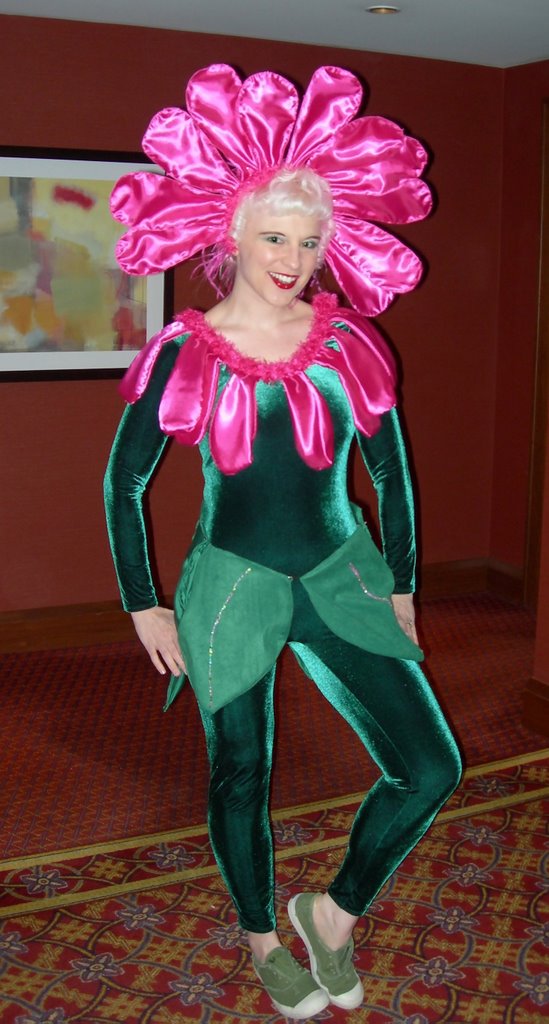
Lisa's flower costume at Casey conference


Part of the "It's My Life" conference included a Halloween party. I had sewn my flower costume ahead of time (created my own pattern and everything).

As it turned out, I was unable to attend the party, because of setting up everything for the Living Room, but I wore this in the Living Room that night for the youth activities.

Lots of the foster youth wore their costumes, too, but I was unable to take photos of them due to legal concerns (chaperones couldn't sign photo releases, and there was a risk that if I had taken photos, future youth wouldn't have been allowed to attend).

Wednesday, November 01, 2006

2006 It's My Life conference - Lisa's experience

I have had the most amazing time at the 2006 It's My Life Conference, sponsored by the Casey Foundation. This is their 4th annual conference to support youth aging out of foster care. I attended for the first time.

Friday night, the night before my flight, I got a call from Foster Care Alumni of America asking me to take charge of all the youth activities in the "Living Room," since Misty Stenslie, the person in charge, was very sick. I said, yes.

It was a lot of work... The phrase "sleepless in Seattle" has an entirely new meaning for me now, because I totally didn't get much sleep.

But it was so rewarding and so much fun! After my flight arrived on Saturday, I sorted through the boxes that had been Fed-Exed to me and pulled everything together, including creating an outline of shifts for volunteers to help me supervise the Living Room.

Activities: There were two afternoon workshops on Sunday and Monday. On Sunday night, I hosted an ice cream social, as well as other activities. One Monday night, we had a karaoke and DDR (Dance Dance Revolution) contest and the winner got to keep the Play Station, mike and software.

Tuesday morning, I announced the prizes for participants who had made postcards to share a part of their experience in foster care. We did a drawing; prizes included an ipod, digital camera, Best Buy gift cards, Target gifts cards and coupons for various fast food establishments.

I had lots of food coupons and so I was able to reward youth for taking on leadership roles, such as judging the contest, and also reward chaperones who volunteered to work shifts helping to supervise the Living Room activities.


I also met the most amazing people. Back in 1989, when I aged out of foster care at age 16, I felt very alone (at least for the first two years, until I moved into a Methodist dorm and was surrounded by college friends who became my "family").

Spending so much time with foster youth, I heard many of their stories... I was both happy to hear of how things in foster care have progressed in some areas, and saddened to hear how they still need to be improved in others.

The three-day conference was filled with interesting contacts and conversations -- drama and adventures... I left feeling very exhausted, but also rejuvenated and incredibly happy.

I will share what I have learned in upcoming blog entries...

Thursday, October 26, 2006

It's My Life conference for youth aging out of foster care

I apologize if my blog entries have been less frequent... I have been preparing to attend and assist with an upcoming conference in Seattle...

I vividly remember my entry into the adult world. It was the summer of 1989. I had been living in a group home, and the director's son had crept into my room, late in the night, and violated me. When I spoke to the director about what had happened, his primary concern was liability. He sent his son to the military, and kicked me out of the group home.

I was sixteen years old. I had just been raped. Now, I didn't know where I was going to live. I felt like I was being punished for not being strong enough to defend myself against what was happening to me.

In one of the most supreme examples of divine providence of my life, I ended up starting college that fall. A sixty-year-old woman whom I had known in my childhood agreed to be my temporary guardian. The following year, I was legally emancipated and moved into my first apartment.

I was book-smart and life-dumb. I didn't know how to cook. The food at the group had just been delivered to us, mysteriously, like manna from above. I didn't know how to budget, nor how to drive. Not to mention the emotional baggage that I was carrying around with me.

It was a long journey from where I was back then to the person I am today. For two weeks, I was homeless. For eight years, I was afraid to date. I often despaired of ever having a family of my own.

Now, I have a husband and two stepdaughters. Would you like to see them? Please visit www.sunshinegirlonarainyday.com or www.nofearinlove.com

My husband is a songwriter. Would you like to hear his music? Please visit www.nathansbrain.com

I went from a place of being unwanted to being sheltered and needed and loved. I achieved my college and graduate level degree. At this time, I am incredibly happy with my life.

And yet...

I worry about current foster children, and people who have aged out of care. Why must the journey be so difficult and treacherous? Couldn't we do something to make the path easier for teens aging out of foster care to travel?

That's why I'm so excited about volunteering to assist with the fourth annual "It's My Life" conference. Because its purpose is to assist youth who are transitioning from foster care to adulthood. I promise to share a full report when I get back!

For more information, please visit:
http://www.casey.org/Resources/Projects/ItsMyLife/

Friday, July 21, 2006

Making the most of every opportunity

As mentioned in a previous post, I have been chosen to help design the Ohio chapter of FCAA. As co-founder with my friend Gayle, my first challenge will be getting in touch with foster alumni throughout the state, and inviting them to help positively influence nationwide policy.

History of Foster Care Alumni of America
In 1999, the Casey Foundation conducted the largest ever retrospective study of foster alumni. Their research was based on extensive interviews with 1400 foster alumni, who had aged out of care between 1966-1986.

Because this study was the first of its kind, they had no idea what to expect. One thing that they didn't expect was that every participant, whether their ultimate placement had been positive or negative, wanted to change the foster care system.

They were actively engaged on all levels. One woman who was destitute, spent hours talking on a calling card, in the hopes that her experience could be used to positively impact others.

As a result of their findings, the Casey Foundation founded an Alumni Relations Board in 2000. Two years later, the board recommended the need for a national organization. Why? Because foster alumni needed to have a collective voice.

FCAA achieved national 501 3c status in 2004. In May of 2006, representatives from seven states (including yours truly) attended the summit in Seattle.

The need for a collective voice
Foster care alumni are an invisible population. If you met me, you wouldn't know I grew up in foster care unless I told you. There is no scarlet "F" label on my chest.

Because of the stigma and stereotyping that most foster youth experience growing up, alumni are often reticent to identify themselves as former foster children. We have experienced firsthand the low expectations and lack of credibility that foster youth are often afforded.

It has been a conscious choice on my part to identify myself with my past. I do it because of my passion to speak up for those who cannot speak for themselves.

But, a national foster alumni organization takes this idea one step further: It empowers foster alumni to speak for themselves.

Connecting with other foster alumni
Many challenges are inherent in trying to arm the passion and power of former foster children. We have learned not to connect, not to commit, not to trust. We have learned to be individuals, and to stand on our own. We have experienced feeling "different," which often leads to self-isolation.

So, how can we connect with one another? Trust one another? Work with one another, when our first impulse will be to tackle problems individually?

Obstacles exist, but I believe the outcome is worth the effort. Before leaving for my trip to California, I printed out 200 fliers, inviting adults who grew up in group homes, foster homes or with a relative (kinship care) to contact me and be a part of Ohio FCAA.

My initial plan was to visit every Krogers in town and post fliers on the bulletin boards. Unfortunately, Krogers have replaced their bulletin board with plastic display cases, and wire shelves designed specifically for Krogers-approved publications.

My back-up plan was to post fliers all over the local college campus, with the help of my oldest stepdaughter. I also visited every store downtown in the Short North area. This is an area frequented by people of all backgrounds, from professionals to college students, to homeless individuals.

I posted fliers in college coffee shops, tattoo parlors, downtown restaurants, laundrymats and car repair establishments.

Opportunity for a television appearance?
I have recently been in contact with Michael Bloom, the associate producer of the Dr. Keith Ablow Show. He is looking for a foster child or alumni who is struggling.

Here is the dilemma, as I see it:
Mr. Bloom has a deadine to deal with... He seems to be sincere in his belief that Dr. Keith Ablow is a reputable and sensitive doctor. He cannot understand why different agencies that he has contacted, including Foster Care Alumni and the California Youth Connection, appear to be stonewalling him.

The way he sees it, this could be a great opportunity for someone. Free counseling, and the show would pay for their follow-up care. The reason that Mr. Bloom works for the Dr. Keith Ablow Show is because he believes that it positively changes lives.

However, I can also understand why organizations might hesitate to respond. When I received Mr. Bloom's email, my first instinct was to feel protective...

My concerns:
1.) Not to betray anyone's trust. (I will not give out contact information for the foster youth / alumni that I am in contact with without their permission).

2.) What I call the "Drew Barrymore syndrome:" If you take an emotionally raw person and they air their experiences publicly, that is very sensitive information that they are putting out there. It could potentially follow them throughout their life.

Foster children already grow up with a case file, which is not always permanently closed when they reach adulthood. They don't need to be haunted by anything else.

3.) Not to waste an opportunity to give a voice to someone in/from foster care. There are many emotional issues affliction foster children that can and should be brought to life. Post-traumatic stress disorder is one of them.

Foster alumni often don't have medical insurance. If the show provided follow-up therapy, that would be a generous and helpful gift. It might lead to greater emotional health and healing...

I think that the two biggest challenges that Mr. Bloom faces in trying to find foster youth/alumni willing to appear on the show are:

1.) We as foster youth don't want to come across as weak, needy or broken. Not allowing us to talk about our successes and progressive healing is a turn-off. We need to be able to say how far we've come, before we risk the vulnerability of sharing an area or two wherein we might still need to heal.

2.) The television format is "now, now, now." If you really do want to contact someone straight off the streets, homeless due to aging out of foster care without proper resources and/or emotionally raw, you have to put in some time.

You will have to earn their trust. Work at it. Foster alumni have often been exploited in the past, and they will be ultra-sensitive to being exploited in the future.

For you, it's a show. For them, it's their life. Because deep-down, underneath the tough exterior that we might put on, foster care alumni are vulnerable.